
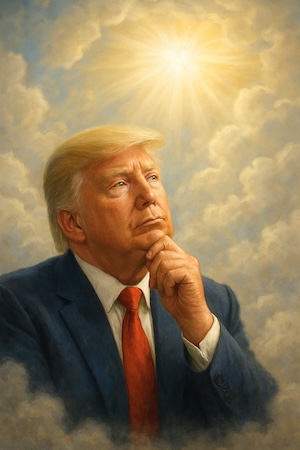
If Alf and the thousands of other deceased communicators who speak from the other side are correct, Trump is wise to ponder whether he’s going to heaven before he departs this world.
In an interview with Fox & Friends on August 19, 2025, while discussing the challenges in dealing with the war in Ukraine, President Donald J. Trump said:
“I just wanna end it … If I can save seven thousand people a week from being killed—I think that’s—I want to try and get to heaven if possible. I’m hearing I’m not doing well. I hear I’m really at the bottom of the totem pole. But if I can get to heaven, this will be one of the reasons.”
Of course, for the cynical atheists among us, Trump’s words can be seen as delusional rantings designed to appeal to his evangelical base, but for the theists and those who have experienced communication with deceased people—and remain open to it—considering the consequences of this life in the next one is a real proposition.
Trump’s predecessors—Bush, Obama, Bill Clinton, and Biden—have all spoken about their Christian faith, but I don’t recall any of them publicly expressing personal anxiety about whether they would go to heaven when making major decisions that affected the lives of millions of people.
Trump, not known for being a pious Christian, does appear to be contemplating the possibility of how the consequences of his decisions might affect his personal situation after this life. The question is: is that a good idea?
In 1960, at a sitting of direct-voice medium Leslie Flint, mentioned in my book No One’s Dead: The Jesus Messages, a man came through who identified himself as Alf Pritchett, who died in World War I. Alf sounds like a working-class English southerner—a Londoner, probably killed when he was still a teenager.
When asked about the circumstances of his death he replied, “Yeah, I came over during the first lot. 19 … 19 … er … must have been 1917 or 18. I’m not sure meself now. It’s such a long time ago.”
After coming to the realization that he was dead, Alf was taken to what he described as a hospital, where he sat round a table with some others who’d also recently arrived. A man next to him introduced himself, and Alf asked how he was settling in.
“Very nice,” he says. “Much better than what they used to tell us down there innit?”
“So I said, ‘how do you mean?’
“Well, you know what they used to tell us down there, about ‘eaven and ‘ell, and the last trumpet and all that? ‘Yeah,’ he says. ‘They’ve got it all wrong.’
“So I says, ‘well, it seems like it, doesn’t it?’
“So he says, ‘yeah.’ He says, ‘all that business about, if you’re very good, you go up to the top stall and if you’re not so good, you’d go down in the old cellar. Ha!’ …
“He says, ‘you seem to have taken it all right.’
“So I said, ‘what else can you do? You’re told you’re kicked … you’re dead. The best thing to do when you’re dead, I should think, is to follow out the instructions and behave yourself. After all, you never know who’s going to be judging on you and all that,’ I said. ‘According to what the old Bible says and what I understood, you got judged.’
“Ah,” he says, “get away with that!” he says. “No one judges you, from what I can make out on it. You judge yourself. You sort of … I know,” he says, “since I’ve been here,” he says, “I’ve been sort of reflecting, you know. Going back a bit on the old past and wondering and thinking about things.” He says, “I realize now, like many people of course, I made many mistakes. I was a bit of a fool, you know, to meself and other people.
“‘But,’ he says, ‘I’m gradually beginning to see now. Even though I’ve only been here a little while,’ he says, ‘there is no such thing as judgment, not in the old-fashioned idea that the old church teaches.’ He says, ‘The only thing is,’ he says, ‘you judge yourself. After all, it’s your conscience,’ he says. ‘I’ve got one, and so have you, I bet. We all have.’
“So I said, ‘well, I’ve got a bit of a conscience all right but,’ I said. ‘Of course, I haven’t lived all that long to have done all that much bad, as far as I know.’ I said, ‘As far as I can remember, the only thing I ever did really wrong was, was drowning a cat.’ … ‘I haven’t done anything really bad. I mean, I ain’t like some of these people. The only thing I can think of doing anything bad, if it is bad at all, and it’s not altogether my fault because I was forced into it, is killed a few Germans,’ I says. …
‘But other people who really, when you come to think about it, don’t risk their lives at all. They sit back and more or less in comfort and smoke their cigars and what have you,’ I said. ‘We’re the ninnies aren’t we?’
“So he says, ‘you’re telling me, boy.’
“He said, ‘you don’t want to worry about those financiers and all the rest of it, they’re all right. They’ll come through all right, but what good will it do ’em? What will they have to answer when they get here? You think that one out,’ he said to me.
“He said, ‘you’ve got nothing on your conscience, mate, but by Christ, they’ve got a hell of a lot on theirs and the others who are responsible for putting us in this position.’
“I said, ‘well, I suppose we shouldn’t have any bitter feelings.’
‘No,’ he says, ‘I ain’t got no bitter feelings but what … annoys me and upsets me, is that these people who are the cause of all this, the mere handful, you might say, compared to the untold millions who have to suffer for it. They’re the ones who are really the ones who have got something on their conscience. When they get here, I wouldn’t like to be in their darn shoes,’ he says.”
Trump’s anxiety over his “post-physical life residential status” may or may not be linked to the two reported assassination attempts or his advancing years. Only he really knows. But Alf’s testimony is a reminder that the totem pole is very long and we’re all on it.
Note: Decades after the Pritchett communication, a World War I grave was discovered listing Alfred (Alf) Pritchett—died August 16, 1917, Ypres, Arrondissement Ieper, West Flanders, Belgium. For anyone who is the least bit curious, you can listen to Alf’s 1960 communication here. Even those who are skeptical—treat it as fiction—it’s full of wisdom.
Jonathan Beecher is the author of No One’s Dead: The Jesus Messages, published by White Crow Books. This article can also be found on Substack.

Jon, of course, one doesn’t have to be a cynical atheist to scoff at it all. I’m sure there are many believers who see it as a political ploy. But there is the possibility that last year’s near-miss assassination attempt got him to seriously thinking about it. It doesn’t seem to qualify as an NDE in the Moody sense, but it does in the journalistic usage of the term. I am reminded of your experience, as set forth in your recent book. It doesn’t appear to qualify as an NDE in the Moody sense, but it sure got you thinking existentially.
Mike
Speaking for atheists (and I was one for 44 years), any talk of going to heaven, whether it be Trump, the pope, or anyone else, is nonsense, and if a politician is talking about it, he’s almost certainly thinking about his voters. That’s how my former atheist self would think about it, and I’m not a cynic.
Trump appears to have had what could be described as a near death experience as in a “brush with death,” and he may well have wondered if it was just luck or whether something otherworldly was going on.
I can’t compare my experience to his. The day I came home from the hospital I started writing a journal which I continued for 10 years. It’s been invaluable because memories are tricky and I’m sure I’m capable of creating memories that weren’t really memories. When I look back at that journal, in the days, weeks, and months after the accident I didn’t mention it other than to document having stitches out ( my lip was severed). I didn’t think it was a big deal. It was just one of those things, like breaking a leg doing sport.
But what was a big deal was that I was feeling completely different about everything. Far from thinking I’d had a brush with death, and was lucky (which I may have been), I suddenly had the idea that there is no death and that this isn’t home, which was diametrically opposed to my worldview. However, I didn’t associate these feelings with the accident, which is why it was so strange and troublesome. I couldn’t explain it rationally. It was only the Brian incident a couple of years later (which I couldn’t explain rationally either) which prompted me to read the literature and visit mediums. Until then I didn’t even know what an NDE or a transformative experience was. That sort of thing wasn’t on my radar. Anything religious or occult was just fantasy fiction.
Now I look back, I feel if I’d had the transformative experience without the Brian experience, I would’ve just thought I was having some sort of mental breakdown and carried on. And if I’d only had the Brian experience, I’m almost certain I wouldn’t have bothered reading books about it or visited any mediums. I would’ve just filed it away in my memory bank under interesting. These days I tell myself it was the combination of the two events that took me in a different direction. Whether that was some kind of divine intervention—some plan—or just a coincidence, I don’t know. And I imagine Trump doesn’t either.
This ‘assassination attempt’ turned out to be bogus. That Trump is afraid of death is a matter of course, not because all the people dying in Ukraine, (how about GAZA? )but because he has been lying and cheating and doing harm to others all his life, and still does, big time. But his stupid ‘christian’ followers will lap it up, and that’s exactly what this is all about.
Loes,
I won’t comment further on the assassination attempt other than to say that it certainly wasn’t bogus for Corey Comperatore, the man sitting behind Trump who was killed, or for David Dutch and James Copen, who were both reportedly shot and wounded. For them, and the thousands of others present, I imagine it was very real.
My question is: Was Trump wise to question his situation after death? If we are to believe Alf and thousands of other communicators reporting from the other side, we would all be wise to ask that question.
Alf and the other communicator appeared to be newbies, but they were already becoming aware of their memories from life and of the consequences of their beliefs—some who were with them didn’t yet believe they were dead. Alf said because he died young, all he had on his conscience was killing a cat and a few Germans. But the leaders who forced him to go to war had the deaths of millions on their conscience, Christians or otherwise, suggesting the judgment—with themselves acting as judge, jury, and executioner—would be harsh. As he remarked, “When they get here, I wouldn’t like to be in their darn shoes …”
Trump’s health appears to be notably worse lately.
But any of us, not only those approaching age 80, would do well to contemplate how we have lived and what we might do to improve.
I also sometimes like to imagine what I’ll be getting myself up to in the next world, and not only what might be fun but what kind of work and service I’ll be doing. I suspect it may be simply a somewhat different version of the healing work I do now.
Very interesting that a grave with Alf’s name was actually found!
Elene,
I agree it is interesting that they found Alf’s grave. Keep up the good work!
Elene, good to see your name again. Yes, Trump does appear a little more “tired” now than several months ago, but whether that is “health” or simply being “worn out” from the busy schedule is the question. I’m all for an age limit for our presidents — perhaps 75 upon taking office, and that person would have only one term.
In the high stakes world of politics I wonder just how frequently and for how many minutes do thoughts of personal, long term (after death) accountability occupy the minds of world leaders? Oscar Wilde portrayed Lord Darlington – and those like him – as cynics ‘a man who knows the price of everything and the value of nothing’. Are those totem pole thoughts some sort of appeal to justification? For yet more understanding of his actions? History shows the powerful claim God to be on ‘their’ side. Never, I note, claiming to be on His side! In the recent past ‘We don’t do God’, meaning theology didn’t influence Tony Blair’s government’s thinking. As Wilde has it, thoughts of accountability are about outcomes now. Profit and loss now. Ideas about ethics, justice, morality, philosophy, are just fanciful whims.
Peter, I believe it was Alistair Campbell, Tony Blair’s Director of Communications and Strategy, who describes himself as a hard line atheist, who said “we don’t do God.”
Blair later said he “did do God,” but for political reasons kept quiet about it.
Jon, Thank you. I was recalling watching Alistair speaking on the 1pm bbc news that day. The ‘we’ was resonant of the all embracing ‘royal we’!
Your point is well taken Jon. Judgement is for the self. The voice of the conscience seems liberated when passed over. It can no longer be covered up by vanity, pride or denial.
Greetings all,
I think Trump is a sociopath and a narcissist so I take everything he says with a grain of salt.
Trump aside, I would note that I am rather new to this blog although not new to the topic of the possibility of an afterlife. I have read many books over the years a, including Michael’s (btw,great books) re mediumship, ndes, etc. I have also been in direct contact with scientists doing NDE and mediumship research.
What I cannot understand is if consciousness survives (by this I mean our personality, memories, etc). does our consciousness continue on the other side “forever” (meaning we basically continue our journey on the other side for eternity from where we left off on this earth)? I realize there is no concept of time on the other side but it always bothered me the notion that our personality (memories, etc) just continued on “forever” after we die. Would that not get boring at some point? What is is we do on the other side (continue to evolve spirituality but why do we need “forever” to do this as opposed to just becoming fully spiritually evolved shortly after death?). I had a reading with a medium years ago after a family member died and they got so many details correct about my family member that odds of guessing things correctly would have been 1 in over 60 million (I calculated rough odds at the time)-this was not a cold reading, done over the phone where I said nothing about my family member and nothing was written about the on the internet. Despite this very meaningful reading I find it difficult to believe my family member (if they did indeed communicate the first time) after all these years since the first reading is “sitting” around (or whatever) over on the other side able to communicate, yet again, via a medium if I tried to connect.
There are some things that, to my way of thinking, hint at consciousness surviving, but a part of me thinks it absurd to believe our personalities just continue on over on the other side where we meet up with our family members, pets… live in houses, etc (as many afterlife believers would argue)-this sounds like nonsense (wishful thinking on the part of the living who want to believe we live on the other side much as we do here but without the pain and suffering we experience in this life). If I had to bet I think I would bet that when we die there is nothing, i.e.our personalities do not survive.
I like to read both sides when it comes to consciousness survival. Chris French, British psychologist for many decades growing up believed in the paranormal but as time went on and he spent more time studying mediumship, ndes, etc. he came to the conclusion that there is no convincing evidence for consciousness surviving death (he is familiar with all the mediumship research of the 1800s and 1900s by William James and others, all the NDE research undertaken by highly credible MDs, etc. so he is not a person speaking out of ignorance).
All your thoughts are appreciated as I guess I am just confused and don’t know what to believe.
Regards,
Ian
Ian,
I remember having a conversation with one of Chris French’s peer’s — a fellow SPR council member, and I asked him “What’s the story with Chris French? There’s so much evidence going back centuries, whether it be mediumship, remote viewing, NDEs, deathbed visions, etc., how can he just deny all of it?” He said “Chris is a really nice guy. He’s got a wife and kids and he makes a very good living by saying “no.” He is a professional skeptic and the day he says “yes” the work will dry up.”
I’ve never met Chris French nor read any of his books so I can’t comment further.
With regards to what happens after death, all I can say is, unless you’ve had your own experience, which has convinced you, read the literature. There’s a quote attributed to Martin Luther, and like many good quotes there’s no written evidence that he actually said it: “A man has to do two things alone. He has do his own believing and his own dying.” I think that’s a truism. Good luck!
Richard Wiseman, another high profile skeptic, was overheard saying words to the effect that skepticism is a very lucrative business. This was at an SPR conference and reported by the widow of the late Monty Keen.
Mickey,
And don’t forget Susan Blackmore, who reportedly had a drug/psychedelic-induced OBE, and is always wheeled out when media outlets want a “professional sceptic” to try to debunk NDE researchers such as Pim van Lommel, Bruce Greyson, Raymond Moody, Sam Parnia, and others.
The trio are all psychologists. It is sometimes said — by critics of mainstream psychology — that psychologists will be the last to accept ESP and survival, since doing so would overturn the materialist philosophy on which the field is largely based.
Jon,
William James, who spent decades researching mediums spent many of those years thinking he was wasting his time until he came across his “white crow”. That said, even after he researched Piper’s mediumship (based on biographies I read about James) he was not 100% convinced there is an afterlife. I think one can read as much literature as one wants and one can still argue either side so, like religion, it comes down to belief. I think both sides of the consciousness survival question can be very dogmatic, each side certain they are correct.
Ian